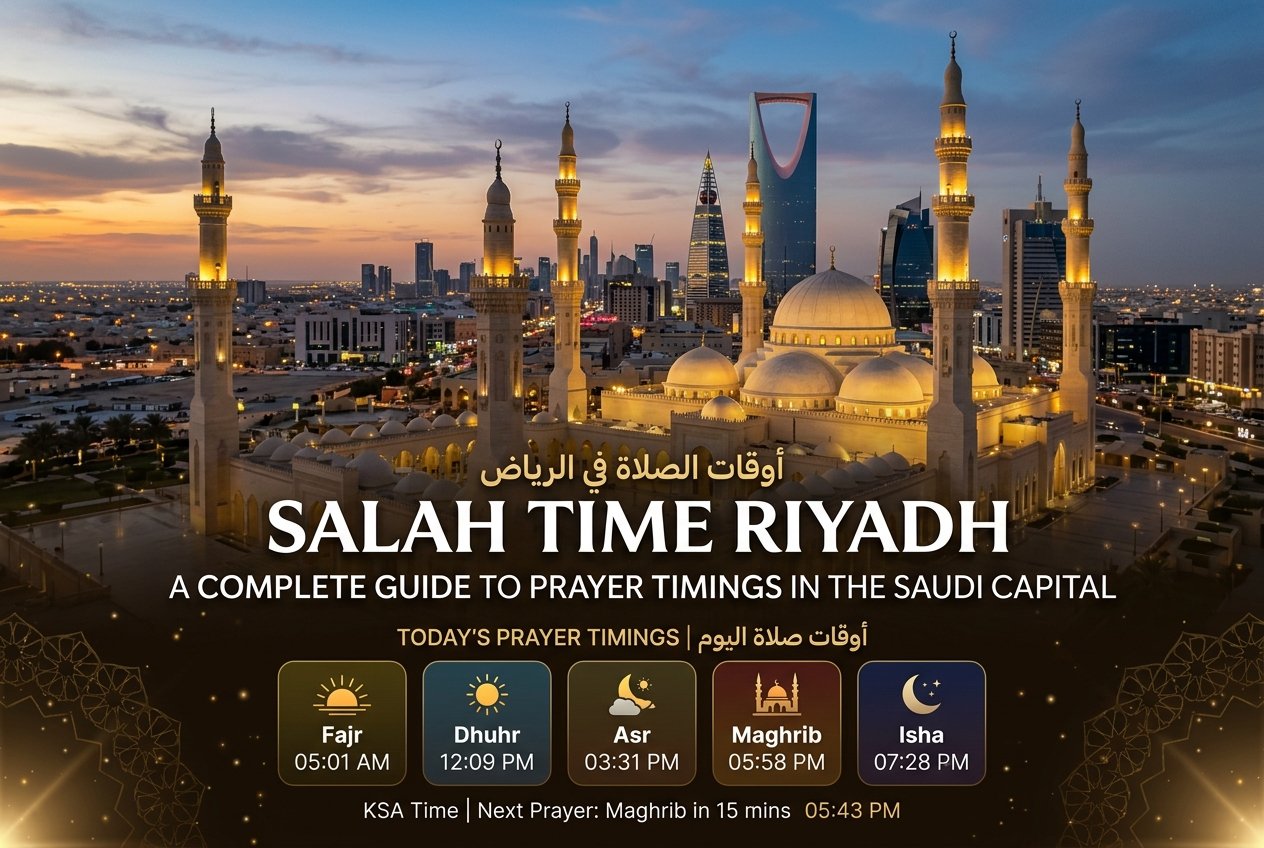
Long before mobile apps existed, the people of Riyadh set their entire day around the movement of the sun, and that tradition still shapes daily life in the city today. Salah time in Riyadh refers to the five daily prayer timings — Fajr, Dhuhr, Asr, Maghrib, and Isha — calculated specifically for the city’s geographic coordinates using the official Umm al-Qura method followed across Saudi Arabia. Unlike a fixed clock schedule, these timings shift slightly every single day because they are tied directly to the sun’s position rather than a static hour.
For residents, expatriates, and visitors alike, knowing accurate salah times in Riyadh is essential not just for worship but for planning work schedules, travel, business meetings, and daily routines around the call to prayer. This article breaks down how these timings work, what factors influence them, and why staying updated matters.
1. Based on the Umm al-Qura Calculation Method
Riyadh’s prayer timings follow the Umm al-Qura University method, the official standard used across Saudi Arabia by mosques, government institutions, and religious authorities. This method calculates Fajr at roughly 18.5 degrees below the horizon and sets Isha at a fixed 90 minutes after Maghrib, extending to about 120 minutes during Ramadan. Because it is the government-endorsed system, it ensures consistency between what you see on an app and what is announced from the local mosque loudspeaker.
2. Five Daily Prayers, Each With a Distinct Window
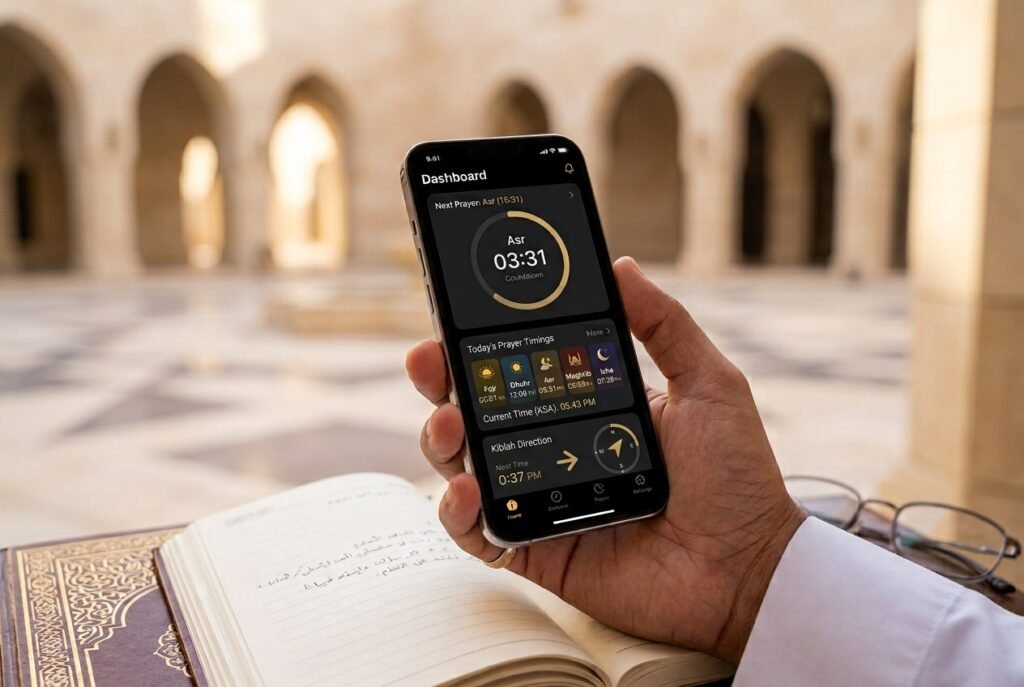
Salah in Riyadh consists of Fajr, Dhuhr, Asr, Maghrib, and Isha, and each has its own start and end window rather than a single fixed moment. Fajr begins at true dawn and closes at sunrise, Dhuhr starts once the sun passes its zenith, Asr begins when a standing object’s shadow lengthens beyond a set ratio, Maghrib starts immediately at sunset, and Isha begins once twilight fully disappears. Understanding these windows helps worshippers avoid praying too early or too late.
3. Times Change Daily With the Sun’s Position
Because prayer times are derived from solar movement rather than the clock, Riyadh’s schedule shifts by roughly one to three minutes every day. Over the course of a year, this creates dramatic seasonal swings — Fajr can fall near 3:30 AM during peak summer and closer to 5:20 AM in winter, while Isha moves in the opposite direction. This is why relying on last week’s printed schedule can quietly throw off your prayer routine, and daily verification matters more than it might seem.
4. Asr Timing Depends on the Juristic School Followed
While the majority of mosques in Riyadh apply the Standard (Shafi’i, Maliki, Hanbali) method for Asr, where the prayer begins once an object’s shadow equals its own height, some worshippers and apps also offer the Hanafi option, which delays Asr until the shadow doubles in length. This distinction typically creates a gap of thirty to sixty minutes between the two calculations, so it’s worth confirming which school your local mosque or community follows before setting reminders.
5. No Daylight Saving Adjustments
Saudi Arabia does not observe daylight saving time, so Riyadh’s salah schedule is driven purely by astronomical calculation without the artificial one-hour shifts seen in many other countries. This keeps the relationship between clock time and actual sun position stable year-round, though the natural seasonal drift described earlier still applies. Travelers coming from DST-observing countries should note this difference when syncing their prayer apps.
6. Minor Variations Across Riyadh’s Neighborhoods
Even within a single city, prayer times can vary by a minute or two from one district to another because of small differences in longitude, latitude, and elevation. A worshipper in northern Riyadh may see a Maghrib time that differs slightly from someone in the southern outskirts. Most reputable prayer-time platforms account for this by using precise GPS coordinates rather than a single citywide average, so enabling location access on your app typically improves accuracy.
7. Jumu’ah Replaces Dhuhr on Fridays
On Fridays, the congregational Jumu’ah prayer takes the place of the regular Dhuhr prayer for Muslim men, and it is strongly encouraged for women as well. Mosques across Riyadh hold a khutbah, or sermon, before the prayer begins, which means the effective “Dhuhr slot” on Friday often runs a bit later than on weekdays to accommodate the sermon. Government offices and many private businesses adjust their midday breaks accordingly.
8. Adjusted Timetable During Ramadan
During Ramadan, Riyadh’s Isha calculation extends slightly, typically to around 120 minutes after Maghrib instead of the usual 90, to allow time for Taraweeh prayers and community gatherings. Fajr also marks the end of Suhoor, while Maghrib signals Iftar, making these two timings the most closely watched of the year. Mosques and city authorities often publish dedicated Ramadan calendars to reflect these seasonal shifts.
Frequently Asked Questions
1. Which calculation method is used for salah time in Riyadh?
Riyadh follows the Umm al-Qura University, Makkah method, which is the official calculation standard adopted by the Saudi government, mosques, and the Ministry of Islamic Affairs across the country.
2. Why do prayer times in Riyadh change every day?
Prayer times are determined by the sun’s position relative to the horizon rather than a fixed clock hour, so as the earth’s tilt and orbit shift throughout the year, Fajr, Maghrib, Isha, and the other prayers naturally move earlier or later by a few minutes daily.
3. Can I use the same salah timetable for the whole month?
It’s better to avoid this, since even small daily shifts accumulate over weeks and can create a noticeable gap between a fixed printed timetable and the actual sun-based timing. Checking a live, daily-updated source or app is the safest way to stay accurate.
Conclusion
Salah time in Riyadh is far more than a simple list of numbers on a screen — it reflects centuries-old astronomical tradition adapted for modern life in one of the world’s fastest-growing capitals. From the Umm al-Qura calculation method and daily solar shifts to Ramadan adjustments and neighborhood-level precision, understanding how these timings work helps residents and visitors stay connected to their daily worship without confusion.
Whether you rely on a mosque announcement, a dedicated prayer app, or a live online timetable, the key is checking accurate, up-to-date sources rather than static schedules. With this foundation, staying aligned with Riyadh’s five daily prayers becomes a straightforward part of everyday life rather than a guessing game.