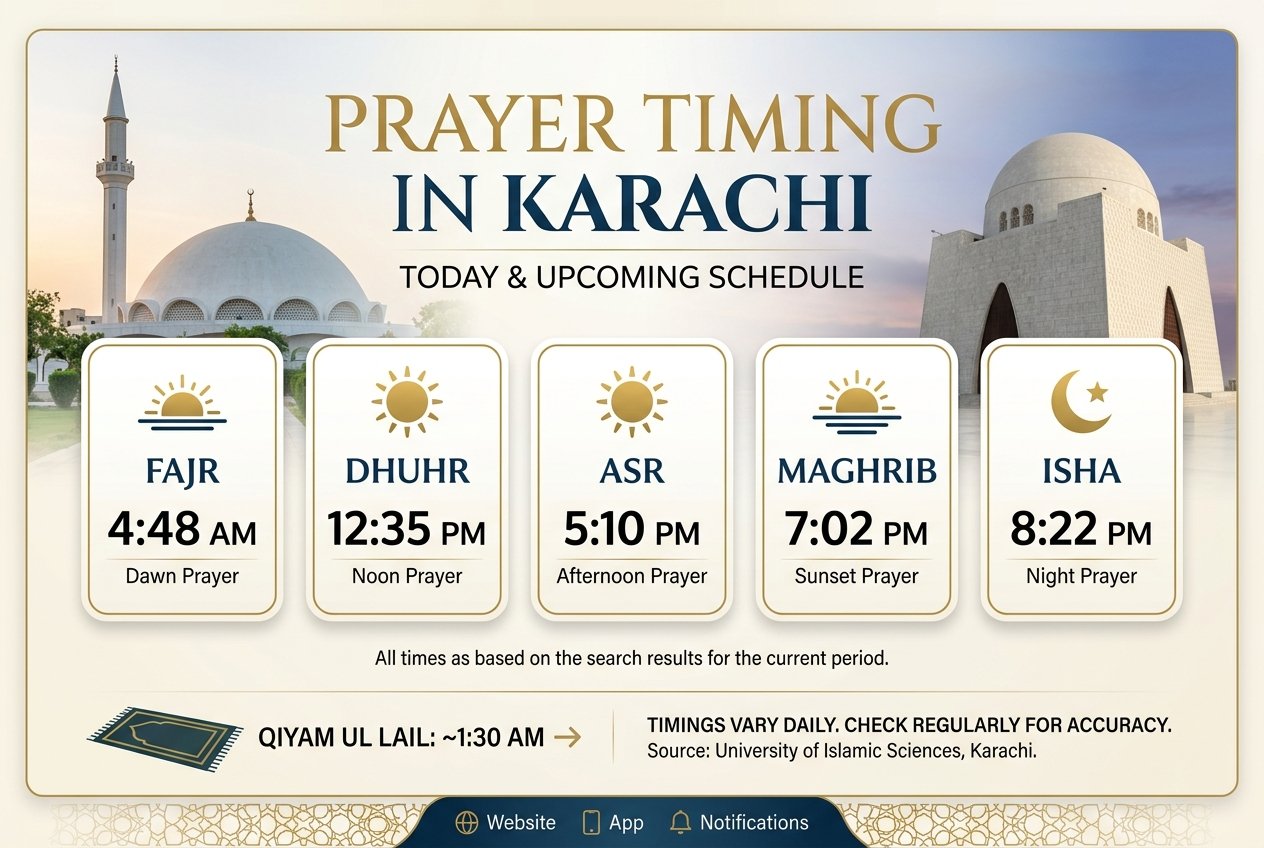
Karachi, Pakistan’s largest city and a coastal metropolis on the Arabian Sea, is home to millions of Muslims who organize their daily routines around the five obligatory prayers. Unlike smaller towns where a single mosque announcement suffices, Karachi’s sprawling geography, dense population, and varying sunrise-sunset patterns throughout the year make accurate prayer timing a genuine necessity rather than a convenience.
Prayer timing in Karachi is calculated using precise astronomical data combined with recognized Islamic jurisprudential methods, ensuring that Fajr, Zuhr, Asr, Maghrib, and Isha are observed at the correct moments as the sun’s position shifts across seasons.
From bustling markets in Saddar to residential communities in Gulshan-e-Iqbal, mosques, mobile applications, and local media all rely on standardized calculation systems to keep the city synchronized in worship. This article explores how prayer timing in Karachi is determined, the features that make timing tools reliable, and answers to common questions residents and visitors often ask.
1. Astronomical Calculation Based on Geographic Coordinates
Prayer timing in Karachi is derived from the city’s exact latitude and longitude (roughly 24.86°N, 67.01°E), which determines the sun’s position at any given moment. Because Karachi sits close to the coast at a relatively low latitude, its day-night length varies less dramatically than northern cities, but the shift is still significant enough that timings must be recalculated daily. Astronomical software tracks solar declination and the equation of time to produce minute-accurate results for each of the five prayers.
2. Hanafi and Shafi Calculation Methods
Pakistan predominantly follows the Hanafi school of thought, which affects how Asr timing is calculated, typically resulting in a later Asr time compared to the Shafi method used in many Arab countries. Most prayer timetables published in Karachi, including those from local mosques and the Jamia Masjid networks, default to the Hanafi method. Users who follow other schools of thought can usually switch this setting in prayer apps to align with their preferred jurisprudential ruling.
3. Seasonal Variation and Daily Adjustment
Karachi experiences noticeable seasonal shifts in prayer timing, with Fajr occurring earlier and Isha later during long summer days, while winter brings a compressed daylight window. This means the gap between Maghrib and Isha, for instance, can shrink or expand by nearly an hour across the year. Reliable timing sources update these values daily rather than relying on a static monthly average, which keeps worshippers aligned with the actual solar cycle instead of approximations.
4. Integration with Mobile Apps and Athan Notifications
Modern residents of Karachi rarely depend solely on printed calendars; smartphone applications such as Muslim Pro, Athan, and IslamicFinder now deliver real-time prayer timing in Karachi with automatic location detection. These apps send push notifications a few minutes before each prayer, play the Azan audio, and even display the Qibla direction using the phone’s compass sensor. This digital shift has made consistent prayer observance far more accessible, especially for working professionals and students navigating busy schedules.
5. Masjid-wise Timing Coordination
While the core astronomical calculation remains consistent citywide, individual mosques in Karachi sometimes adjust the congregational (Jamaat) time slightly later than the calculated Adhan time to allow worshippers time to gather. For example, a mosque may announce Zuhr Adhan at 1:15 PM but hold the congregational prayer at 1:30 PM. Understanding this distinction between Adhan time and Jamaat time prevents confusion for newcomers or visitors unfamiliar with local mosque customs.
6. Ramadan-Specific Sehri and Iftar Timings
During the holy month of Ramadan, prayer timing in Karachi takes on heightened importance as Sehri (pre-dawn meal) must end precisely before Fajr, and Iftar begins exactly at Maghrib. Local media outlets, mosques, and apps publish dedicated Ramadan calendars showing Sehri and Iftar times for each day of the month, since these shift gradually as the month progresses. Precision here matters greatly, as fasting validity depends on adhering strictly to these boundaries.
7. Qibla Direction Alignment
Alongside timing, accurate prayer orientation toward the Kaaba in Makkah is essential, and Karachi’s Qibla direction is calculated at approximately 267 degrees from true north. Most prayer timing platforms bundle Qibla compass features directly into their interface, allowing users to combine correct timing with correct direction in a single tool. This integration reflects how modern technology has streamlined what was once a more manual, mosque-dependent process.
8. Daylight Saving and Time Zone Consistency
Pakistan does not currently observe daylight saving time, so prayer timing in Karachi remains anchored to Pakistan Standard Time (PST, UTC+5) year-round. This consistency simplifies scheduling compared to countries that shift clocks seasonally, meaning residents only need to track the daily solar-based changes rather than accounting for artificial time adjustments as well.
Frequently Asked Questions
1. How is prayer timing in Karachi calculated? Prayer timing in Karachi is calculated using the city’s geographic coordinates combined with solar position data, applying the Hanafi jurisprudential method that most local mosques follow. Specialized software computes daily variations based on sunrise, sunset, and the sun’s angle below the horizon for Fajr and Isha.
2. Why do prayer times differ slightly between mosques in Karachi? Slight differences usually arise because the calculated Adhan time and the actual congregational Jamaat time are not identical; mosques often delay Jamaat by 10 to 20 minutes to allow worshippers to gather. The underlying astronomical calculation itself remains consistent across the city.
3. Does Karachi’s prayer timing change significantly between seasons? Yes, Karachi experiences a noticeable shift between summer and winter, with Fajr occurring earlier and Isha later during long summer days, and the reverse pattern in winter. This is why daily-updated calendars or apps are more reliable than fixed monthly printouts.
Conclusion
Prayer timing in Karachi reflects a careful blend of astronomical science, Islamic jurisprudence, and modern technology working together to serve one of South Asia’s largest urban Muslim populations. From the Hanafi-based Asr calculation to seasonal Fajr and Isha adjustments, and from Ramadan-specific Sehri and Iftar schedules to mosque-level Jamaat coordination, every feature exists to help residents fulfill their daily prayers with confidence and precision.
As mobile apps and digital platforms continue to refine location-based accuracy, staying aligned with correct prayer timing in Karachi has become easier than ever, allowing the city’s diverse communities to maintain this essential pillar of their faith consistently throughout the year.