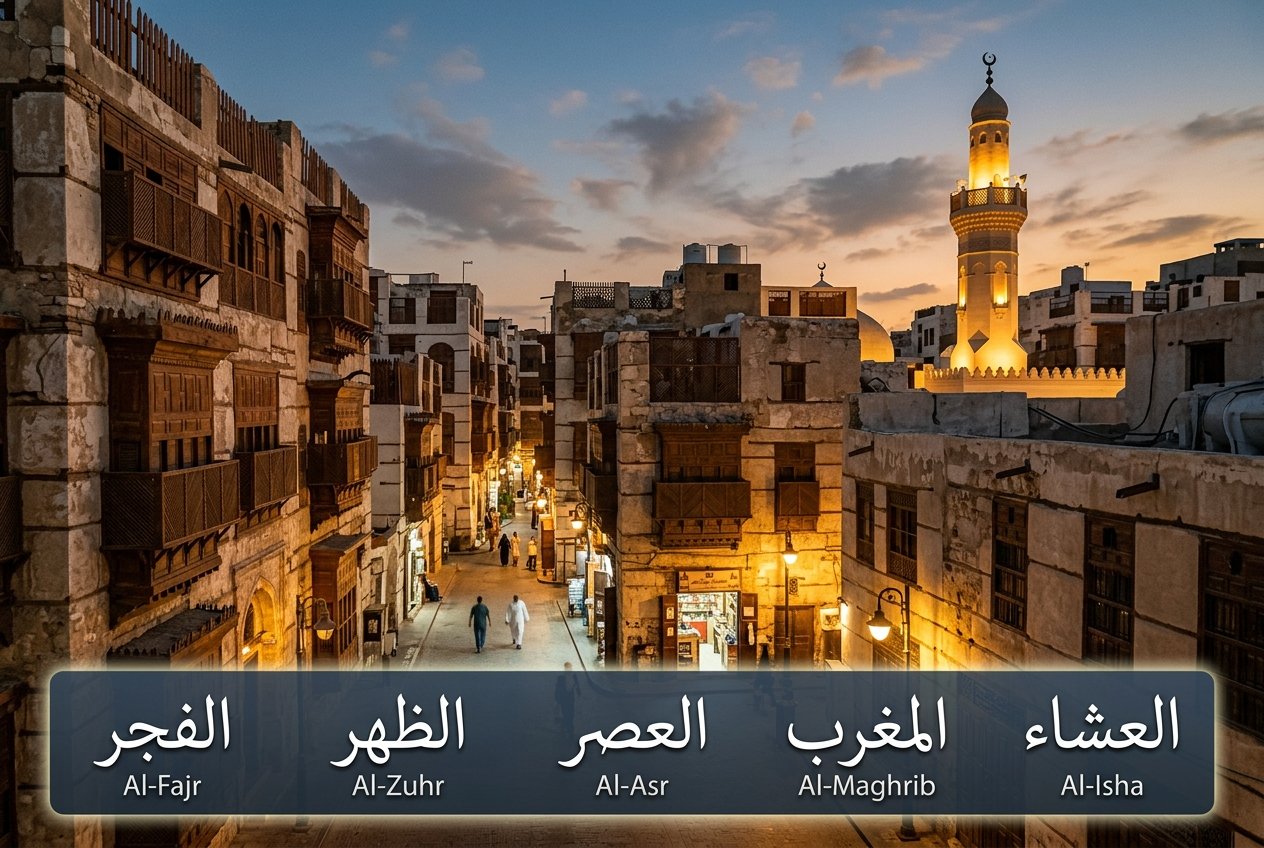
Prayer times in Al-Balad, Jeddah are the daily times for Fajr, Dhuhr, Asr, Maghrib and Isha in the city’s historic district. Al-Balad sits in the same city and time zone (Arabia Standard Time, UTC+3) as the rest of Jeddah, so the times are almost identical across the city. People search for them because the times move every day, and visitors often wonder if the old quarter follows a special schedule. It does not. This guide explains how the times are set, why they change, how to check them, and what to expect when praying in Al-Balad.
What Are Prayer Times in Al-Balad Jeddah?
Prayer times in Al-Balad follow the official Saudi calculation, which is based on the sun’s position and Jeddah’s coordinates. Al-Balad has no separate timetable. Use the Jeddah timetable for the current date. The five daily prayers are Fajr (dawn), Dhuhr (midday), Asr (afternoon), Maghrib (sunset) and Isha (night). The exact minute changes daily, so always check a current, reliable timetable rather than a fixed list.
What Does “Prayer Times in Al-Balad Jeddah” Mean?
Muslims pray five times a day, and each prayer has a time window tied to the sun:
- Fajr: begins at true dawn and ends at sunrise.
- Dhuhr: begins just after the sun passes its highest point.
- Asr: begins in the afternoon, when an object’s shadow reaches a set length.
- Maghrib: begins at sunset.
- Isha: begins once the evening twilight has faded.
Al-Balad means “the town” or “the old city” in Arabic. It is the historic core of Jeddah, known for its coral-stone buildings, wooden balconies (rawashin) and old markets (souqs). UNESCO inscribed it on the World Heritage List in 2014 as “Historic Jeddah, the Gate to Makkah.”
So the phrase combines a religious timetable with a specific place. Most people searching want today’s times, the nearest mosque, or both.
Does Al-Balad Have Different Prayer Times From the Rest of Jeddah?
No, not in any way that matters in daily life. Prayer times depend on latitude and longitude. Al-Balad is a small district in a city that spans a much larger area, so the difference between Al-Balad and other Jeddah neighborhoods is tiny, at most a minute or so. Saudi timetables are published per city, not per neighborhood.
| Question | Answer |
| Separate timetable for Al-Balad? | No, it uses the Jeddah timetable |
| Time zone | Arabia Standard Time (UTC+3), no daylight saving |
| Who sets the official times? | Saudi authorities, based on the Umm al-Qura method |
| How often do times change? | Slightly every day |
How Are Prayer Times Calculated in Jeddah?
Saudi Arabia officially uses the Umm al-Qura method, associated with the Umm al-Qura calendar system in Makkah. It is widely documented in prayer-time software and by calculation libraries.
1. Find the location
The calculation starts with Jeddah’s coordinates, roughly 21.5° N and 39.2° E. That fixes when the sun rises, peaks and sets there.
2. Calculate sunrise, midday and sunset
Astronomers compute the sun’s path for each date. Dhuhr starts after solar noon. Maghrib starts at sunset.
3. Apply the twilight rules
Fajr is set by the sun’s angle below the horizon before sunrise. Under the Umm al-Qura method, Fajr uses an angle of 18.5° below the horizon. Isha is set at a fixed interval after Maghrib, commonly 90 minutes, extended to 120 minutes during Ramadan.
4. Apply the Asr rule
The most common (standard) Asr rule begins when an object’s shadow equals its own length, plus its shadow at noon. Some schools of thought use a later Asr, when the shadow is twice the object’s length. Most apps let you choose, but the Saudi timetable uses one fixed rule.
Example: In summer, the sun sets later, so Maghrib and Isha move later. In winter the reverse is true. Jeddah is close to the equator, so the seasonal swing is smaller than in Europe or North America.
Why Do Prayer Times Change Every Day?
The sun rises and sets at slightly different moments each day as the Earth moves around it. Changes in Jeddah are small, often a minute or less from one day to the next, but they add up over weeks. That is why a timetable printed last month can be a few minutes off now.
Prayer Times vs. Adhan vs. Iqamah: What’s the Difference?
People often confuse these three terms.
| Term | Meaning | Why it matters |
| Prayer time | When the window for a prayer opens | The calculated time in the timetable |
| Adhan | The public call to prayer | Usually announced at the start of the time |
| Iqamah | The second call, just before the congregational prayer begins | Comes some minutes after the adhan, set by each mosque |
If you want to pray in congregation at a mosque in Al-Balad, the adhan is not the moment to leave. The mosque’s own iqamah gap decides when the prayer starts.
Where to Pray in Al-Balad
Al-Balad has many small neighborhood mosques among its old lanes and markets. Two frequently mentioned historic ones are the Al-Shafi’i Mosque and the Uthman bin Affan Mosque. Visitors should confirm current opening details and visitor rules locally, since these can change.
Practical points for visitors:
- Mosques have separate areas for men and women.
- Dress modestly and remove your shoes.
- Expect shops and stalls to be busy just before and after prayer.
- During Ramadan, the area is especially crowded around Maghrib and Isha.
Friday Prayer (Jumu’ah) in Al-Balad
On Fridays, congregational Jumu’ah prayer replaces Dhuhr for those who attend. It includes a sermon (khutbah) before the prayer. Central mosques fill early, so arrive well ahead of time. Timing follows the local Dhuhr window, and mosques announce their own schedules.
Prayer Times During Ramadan
In Ramadan, the schedule matters to fasters in two extra ways:
- Suhoor (the pre-dawn meal) must end by Fajr.
- Iftar (breaking the fast) happens at Maghrib.
Isha is also commonly set later in Ramadan under the Saudi method, and Taraweeh prayers follow Isha. Al-Balad becomes lively at night, but check the timetable for the exact dates each year.
How to Check Accurate Prayer Times in Al-Balad
Verified, most reliable sources
- Official Saudi government and religious-authority announcements.
- Local mosque notices, which show the iqamah times.
- Well-known prayer apps set to the Umm al-Qura method and Jeddah as the location.
Less reliable sources
- Old PDF timetables from earlier years.
- Sites with no stated method or location.
- Apps set to the wrong calculation method, such as one designed for another region.
Tip: Set your app’s method to Umm al-Qura and location to Jeddah, then compare it against a mosque notice. If they differ by more than a minute or two, check the method setting.
Websites such as prayertimejeddah.com can be convenient for a quick daily lookup. As with any timetable site, cross-check against an official source or your local mosque, especially around Ramadan and Eid.
Common Mistakes When Looking Up Prayer Times
- Using the wrong city. A timetable for Riyadh or Madinah will not match Jeddah.
- Wrong calculation method. Different methods use different Fajr and Isha angles, which can shift times by several minutes.
- Confusing adhan with iqamah. They are not the same moment.
- Using an outdated timetable. Times drift through the year.
- Ignoring Ramadan adjustments. Isha timing may differ.
Advantages and Limitations of Online Prayer Timetables
Advantages
- Instant and free.
- Updated for each date.
- Handy on a phone while walking through the old town.
Limitations
- They show calculated times, not each mosque’s iqamah.
- Quality varies between websites and apps.
- A wrong setting can produce wrong times without any warning.
Prayer Times in Al-Balad in Simple Terms
Think of prayer times as a sun-powered clock. The sun’s position tells Muslims when each prayer opens. Because the sun moves a little differently each day, the times shift a little too. Al-Balad is just one neighborhood in Jeddah, and the sun looks about the same from all of it, so the whole city shares one timetable.
Frequently Asked Questions
What are the prayer times in Al-Balad Jeddah today?
They change daily. Check a current Jeddah timetable using the Umm al-Qura method and confirm with your local mosque.
Is Al-Balad’s timetable different from the rest of Jeddah?
No. Al-Balad uses the same Jeddah timetable, and any difference is negligible.
Which calculation method does Saudi Arabia use?
The Umm al-Qura method, with Fajr at 18.5° and Isha set at a fixed interval after Maghrib.
Why is Isha later in Ramadan?
The Saudi method commonly extends the Isha interval after Maghrib during Ramadan.
What is the difference between adhan and iqamah?
The adhan announces that the prayer time has begun. The iqamah is the call just before the congregational prayer starts.
Can I trust prayer-time apps?
Many are reliable, but only if set to the right city and method. Compare against a mosque or official notice.
Do shops in Al-Balad close during prayer?
Practices have changed over time, and rules and customs vary. Check locally rather than assuming.
Can non-Muslim visitors enter mosques in Al-Balad?
Access rules vary by mosque and can change, so ask locally before entering.
Final Takeaway
Prayer times in Al-Balad Jeddah are the same as the Jeddah citywide timetable, calculated with the Umm al-Qura method and changing slightly each day. The most common confusion is thinking the old district has its own schedule, or mixing up the adhan with the iqamah. For the most reliable result, use a current Jeddah timetable set to the correct method and confirm the congregation time at your mosque.
Coming soon with new Topic
- Prayer Times in Al-Safa Jeddah
- Prayer Times in Al-Naseem Jeddah
- Prayer Times in Al-Rawdah Jeddah
- Prayer Times in Al-Hamra Jeddah
- Prayer Times in North Jeddah
- Prayer Times in South Jeddah
- Prayer Times Near King Abdulaziz International Airport
- Mosques to Visit in Jeddah
- Famous Mosques in Jeddah: Locations and Prayer Information