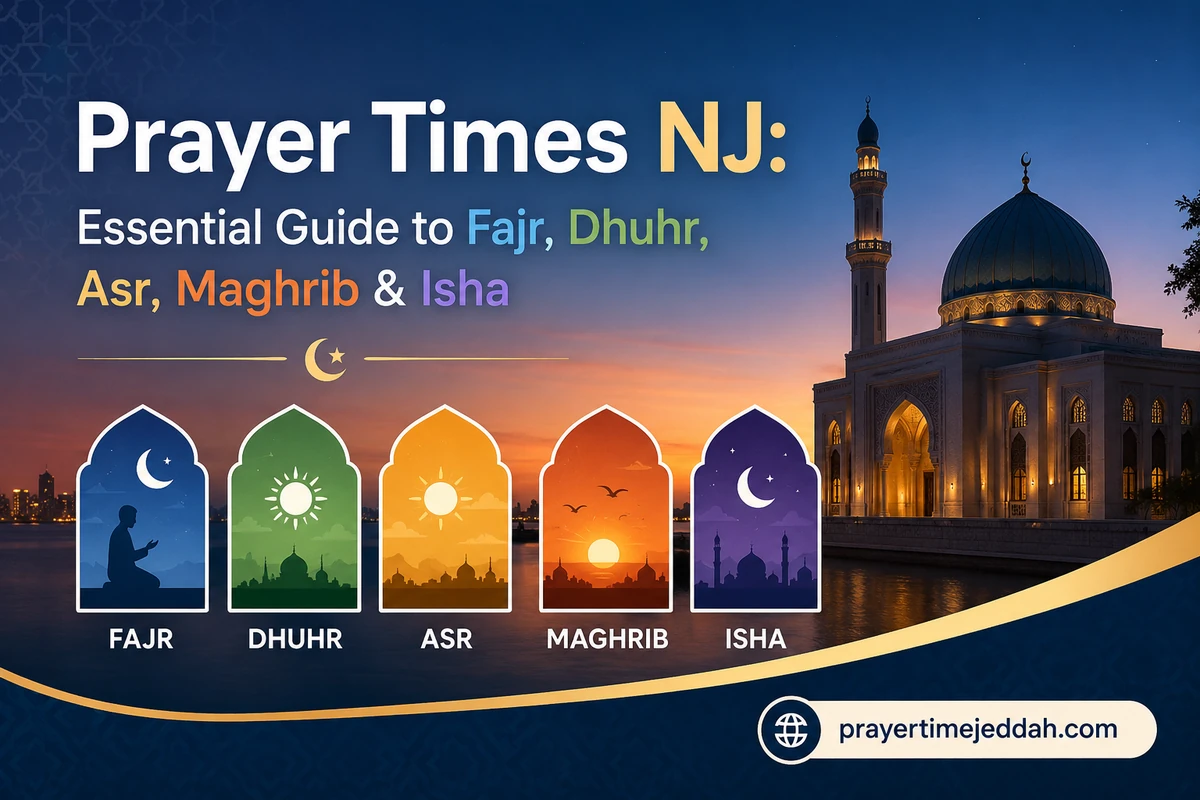
Finding accurate prayer times in NJ is essential for Muslims who want to observe the five daily prayers according to their local time. Because New Jersey stretches across a large area and prayer times change throughout the year, Muslims need reliable schedules that account for location, date, and calculation methods.
Whether we live in Newark, Jersey City, Paterson, Edison, Trenton, Princeton, or another New Jersey community, knowing the correct prayer schedule helps us plan our day around Fajr, Dhuhr, Asr, Maghrib, and Isha.
What Are the Five Daily Prayer Times in NJ?
Islam prescribes five obligatory prayers every day. Their times are determined by the position of the sun, so they don’t remain the same throughout the year.
The five prayers are:
- Fajr – The pre-dawn prayer
- Dhuhr – The midday prayer
- Asr – The afternoon prayer
- Maghrib – The prayer immediately after sunset
- Isha – The night prayer
The exact time for each prayer depends on the date and geographical location. As a result, prayer times in New Jersey can differ slightly between cities.
Prayer Times NJ Change Throughout the Year
One of the most important things to understand about prayer times NJ is that they aren’t fixed.
During summer, daylight lasts longer, causing significant changes in Fajr, Maghrib, and Isha times. During winter, the days are shorter, and Maghrib may arrive much earlier.
For example, sunrise and sunset in northern New Jersey can differ slightly from those in southern parts of the state. Even nearby cities may have small differences because of their longitude and latitude.
For this reason, a prayer schedule should always correspond to the specific city and date rather than relying on a general timetable.
Fajr Prayer Time in New Jersey
Fajr begins at dawn, before sunrise. It is the first obligatory prayer of the Islamic day.
The Fajr period begins when true dawn appears and ends at sunrise. Because sunrise changes significantly during the year, Fajr can occur very early during the summer months and considerably later during winter.
Those who observe Fajr should pay close attention to both the beginning of the prayer window and the local sunrise time.
A reliable NJ prayer times schedule can make it easier to determine when Fajr begins and when the window ends.
Dhuhr Prayer Time NJ
Dhuhr begins after the sun passes its highest point in the sky. It is the second obligatory prayer of the day.
Unlike Fajr and Maghrib, Dhuhr generally doesn’t require us to wake up before dawn or monitor sunset. However, its exact beginning still changes from day to day.
For people working or studying in New Jersey, checking the daily Dhuhr schedule can help with planning a suitable prayer break.
Asr Prayer Time in NJ
Asr is the afternoon prayer. Its calculation can vary depending on the Islamic jurisprudential method being followed.
Two commonly encountered methods are based on different shadow-length calculations. Consequently, two prayer calendars may show somewhat different Asr times.
When comparing prayer times NJ schedules, it’s therefore useful to check which Asr calculation method is being used.
Maghrib Prayer Time NJ
Maghrib begins immediately after sunset. Because sunset changes throughout the year, Maghrib can vary considerably between seasons.
During the summer, sunset may occur late in the evening. During winter, Maghrib can begin much earlier.
Maghrib is particularly important for Muslims who are fasting, because the fast ends at sunset. Accurate local sunset information therefore plays an important role in determining both Maghrib prayer time and the time to break the fast.
Isha Prayer Time in New Jersey
Isha is the final obligatory prayer of the day. It begins after twilight has disappeared sufficiently following sunset.
The exact Isha time depends on the calculation convention being used. In some circumstances, especially at higher northern latitudes, twilight can remain for a long period during summer.
New Jersey experiences noticeable seasonal changes, so Isha may occur considerably later in summer than in winter.
Why Prayer Times Differ Between NJ Cities
New Jersey isn’t a single point on the map. The state covers a broad geographic area, and Islamic prayer calculations depend partly on geographical coordinates.
For example, prayer schedules for Newark, Jersey City, Paterson, Edison, Princeton, and Boston may not be identical.
The differences are usually small, but they can matter when a prayer begins or ends within a narrow window.
Factors That Affect Prayer Times
Several factors can influence a prayer timetable:
- Latitude
- Longitude
- Date
- Sunrise
- Sunset
- Twilight
- Asr calculation method
- Prayer calculation convention
- Local mosque adjustments
Using a schedule calculated specifically for our location is therefore preferable to relying on a timetable from another city.
NJ Prayer Times and Islamic Calculation Methods
Prayer-time calculators use astronomical data to estimate when the sun reaches particular positions below or above the horizon.
Different Islamic organizations and calculation authorities may use different conventions for determining Fajr and Isha. This can lead to variations between calendars.
For this reason, two websites or apps can sometimes display different prayer times for the same city.
This doesn’t automatically mean that one schedule is incorrect. It may simply reflect a different calculation method.
Why Fajr and Isha Can Have Larger Differences
Fajr and Isha are particularly sensitive to calculation methods because both are associated with twilight.
Fajr occurs before sunrise when the sun reaches a specified angle below the horizon. Isha is calculated using another twilight criterion.
Changing that angle changes the resulting prayer time.
Therefore, when comparing prayer schedules, we should pay special attention to the Fajr and Isha calculation settings rather than assuming that every timetable follows the same convention.
Prayer Times NJ for Major Cities
Prayer Times Newark, NJ
Newark is one of New Jersey’s largest cities and has a substantial Muslim population. Local mosques and Islamic organizations may publish their own daily schedules.
Because Newark is close to New York City, some schedules may appear similar to New York prayer calendars, but exact times should still be calculated for Newark.
Prayer Times Jersey City, NJ
Jersey City is located across the Hudson River from Manhattan. Its prayer times are close to those of New York City, although geographical differences can produce small variations.
For daily worship, we should use a schedule specifically configured for Jersey City whenever possible.
Prayer Times Paterson, NJ
Paterson has a long-established Muslim community and numerous Islamic institutions. Residents can find local prayer schedules through nearby mosques and Islamic centers.
Local timetables can also include Iqamah times, which are different from the astronomical beginning of a prayer period.
Prayer Times Edison, NJ
Edison is another major New Jersey community with a large Muslim population. Daily prayer schedules may differ slightly from those in northern New Jersey.
Checking the location and calculation method is especially important when using a digital prayer application.
Prayer Times Princeton, NJ
Princeton and surrounding communities are farther south and west than many major northern New Jersey cities. As a result, their solar times can differ slightly.
A location-specific timetable provides the most useful information for residents.
Prayer Time vs. Iqamah Time
A common source of confusion is the difference between prayer time and Iqamah time.
The prayer time indicates when the period for a particular Salah begins according to the relevant calculation.
The Iqamah is the time when the congregational prayer is actually established at a mosque.
For example, a mosque might list Dhuhr beginning at one time but schedule its congregational Iqamah several minutes later.
When attending a mosque, we should therefore distinguish between the Salah start time and the mosque’s Iqamah schedule.
How to Find Accurate Prayer Times NJ
We can find daily prayer schedules through several sources:
- Local mosques and Islamic centers
- Established Islamic prayer-time websites
- Mobile prayer applications
- Islamic calendars
- Astronomical prayer-time calculators
For the greatest consistency, it is useful to choose one trusted calculation method and use it consistently.
If we regularly attend a particular mosque, following its published schedule can also simplify daily planning, especially for congregational prayers.
How Daylight Saving Time Affects Prayer Schedules
New Jersey observes daylight saving time, which changes the displayed clock time during part of the year.
The astronomical position of the sun doesn’t suddenly change because the clocks move forward. Instead, the clock representation of solar events changes.
This is why prayer schedules can appear to shift by an hour around daylight-saving transitions.
Digital applications generally adjust automatically when the correct location and time-zone settings are selected.
Prayer Times During Ramadan in NJ
Accurate prayer schedules become especially important during Ramadan.
Muslims use Fajr to determine the beginning of the daily fast and Maghrib to determine when the fast ends.
A Ramadan timetable may therefore include:
- Fajr
- Sunrise
- Dhuhr
- Asr
- Maghrib
- Isha
- Iftar information
- Suhoor information
- Mosque Iqamah times
During Ramadan, local mosques may publish dedicated timetables because congregational prayers, including Taraweeh, are often scheduled according to the local community’s calendar.
Prayer Times and Suhoor
Suhoor is the pre-dawn meal eaten before fasting begins.
Because fasting begins at Fajr, Muslims should understand the difference between Fajr time and any additional precautionary time a local mosque may recommend for finishing Suhoor.
A local Ramadan timetable can make this easier to follow.
Prayer Times and Iftar
Iftar begins at sunset, which corresponds to the beginning of Maghrib.
For this reason, an accurate local Maghrib time is particularly important during Ramadan.
Those fasting in New Jersey should use a schedule appropriate for their location rather than relying on a timetable from another state or city.
Using a Prayer Time App in New Jersey
Prayer applications can be convenient because they can automatically update times based on location and date.
However, settings matter.
Before relying on an app, we should verify:
- Location
- Time zone
- Calculation method
- Fajr angle
- Isha angle
- Asr jurisprudence
- Daylight-saving settings
Two users in the same city can receive different times if their applications use different calculation settings.
How to Choose the Right Calculation Settings
There isn’t one universal setting that every Muslim community uses.
The best approach is to determine which calculation convention is followed by the local mosque or Islamic authority we trust.
Then we can configure our application accordingly.
This is particularly useful when differences of several minutes appear between two popular prayer calendars.
Can Prayer Times Be the Same Every Day?
No. Islamic prayer times are connected to the sun, so they naturally change.
The differences may be small from one day to the next, but over several weeks or months they can become substantial.
For example, Fajr may move significantly earlier as summer approaches, while Maghrib becomes progressively later. The reverse happens as winter approaches.
That’s why a daily prayer times NJ schedule is more reliable than memorizing fixed clock times.
Tips for Staying Consistent With Salah
A few simple habits can make daily prayer easier:
1. Enable Prayer Notifications
A trusted app can provide reminders shortly before each prayer.
2. Keep the Correct Location
Make sure the application is using the correct New Jersey city or GPS location.
3. Follow Your Local Mosque
If we regularly pray in congregation, the mosque’s timetable can help maintain consistency.
4. Check Seasonal Changes
Don’t assume yesterday’s prayer times will remain accurate for weeks.
5. Allow Enough Preparation Time
Wudu, transportation, and other preparations can take time. Planning ahead helps prevent rushed prayers.
Frequently Asked Questions About Prayer Times NJ
What time is Fajr in NJ?
Fajr doesn’t have one fixed time throughout New Jersey or throughout the year. It depends on the date, location, and calculation method. The local Fajr time should be checked for the specific city and day.
What time is Maghrib in New Jersey?
Maghrib begins at sunset. Its exact clock time changes daily and varies by location, so a local timetable should be used.
Why do different apps show different NJ prayer times?
Different applications may use different astronomical calculation methods, Fajr and Isha angles, Asr conventions, or local adjustments.
Are prayer times the same throughout New Jersey?
No. Prayer times can vary slightly between different locations because of geographic differences.
Which prayer time comes first?
Fajr is the first of the five obligatory daily prayers.
What is the difference between Salah time and Iqamah time?
Salah time indicates when the prayer period begins, while Iqamah refers to when the congregational prayer is established at a mosque.
Does daylight saving time change prayer times?
It changes the clock time displayed for solar events. The sun’s actual position is not altered by changing the clocks.
Where can we find reliable prayer times in NJ?
We can consult a trusted local mosque, Islamic center, established prayer-time service, or properly configured prayer application. For the most relevant schedule, the source should use our specific location and a calculation method accepted by our local community.
Final Thoughts on Prayer Times NJ
Accurate prayer times NJ information helps us organize the day around the five daily Salah. Since prayer times depend on astronomical conditions, they naturally change with the date and location.
The most dependable approach is to use a location-specific timetable, understand the calculation method being used, and compare it with the schedule followed by a trusted local mosque when necessary.
With the right schedule and consistent reminders, keeping track of Fajr, Dhuhr, Asr, Maghrib, and Isha becomes a simple part of everyday life.